Denise F Connelly, MSc, PGCE, BA (Hons)

Instructional Designer • eLearning Developer • LMS Administrator • Content Developer

Portfolio

Designing high-quality digital and blended learning

I design and lead the development of engaging, accessible and pedagogically robust digital and blended learning across higher education, humanitarian and public-sector contexts.

My work spans learning architecture, behavioural and scenario-based design, digital production, stakeholder collaboration and evaluation. I have developed enterprise-scale programmes for international humanitarian organisations, emergency services and universities, consistently applying evidence-informed pedagogy, modular design principles and measurable impact evaluation.

Selected examples below illustrate this approach in practice - projects span university, emergency service and international humanitarian contexts.

Examples from my recent role at the University of Manchester, where as an eLearning Support Officer I designed and developed digital learning resources, supported staff capability development, and administered the LinkedIn Learning platform for students and staff.

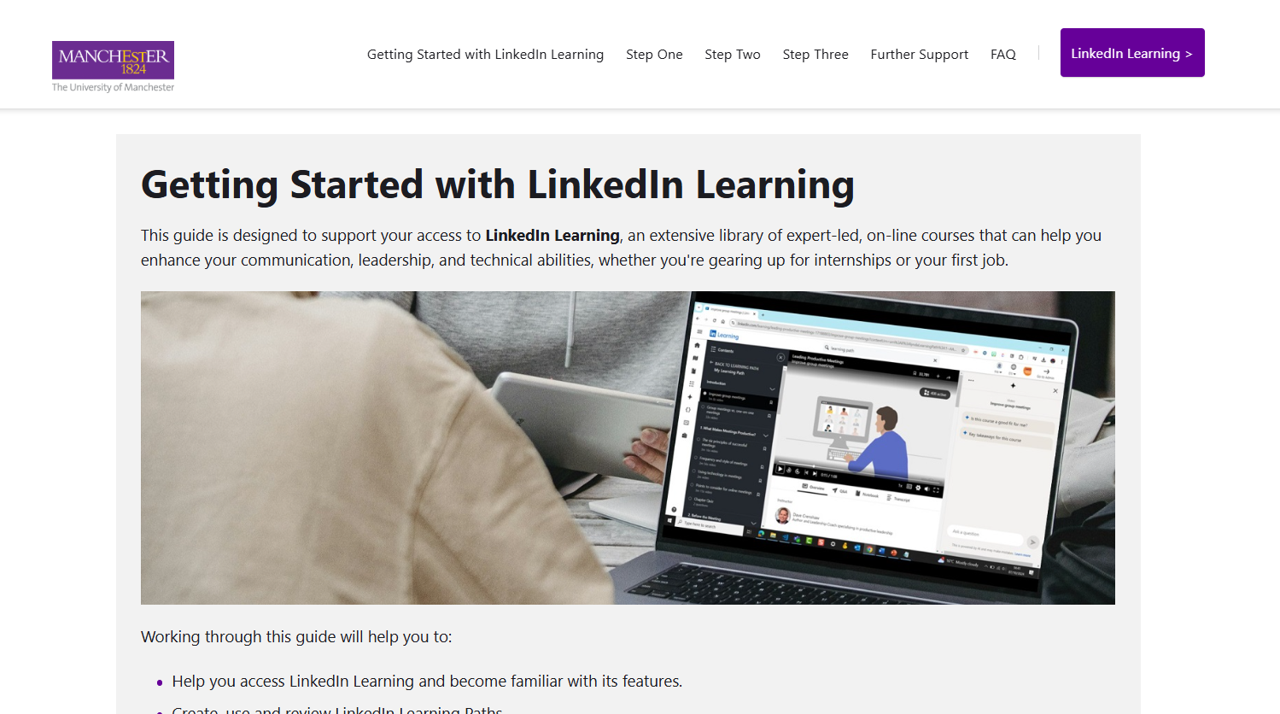
University of Manchester web page: Getting Started with LinkedIn Learning, showing clear headings, step-by-step access instructions and accessible layout. HTML / CSS
Accessible web guidance page providing a single clear entry point for students and staff.

Getting Started with LinkedIn Learning

  • Context: Users arrived at the platform without knowing how to log in or start, generating repeated support queries.
  • My role: Wrote and structured the page content; applied accessible layout within university web standards.
  • Approach: Plain-English guidance, scannable headings and a logical flow from access to first use.
  • Goal: Reduced inbound support queries; now the primary self-serve reference linked from platform communications.

View live web page (opens in new tab)

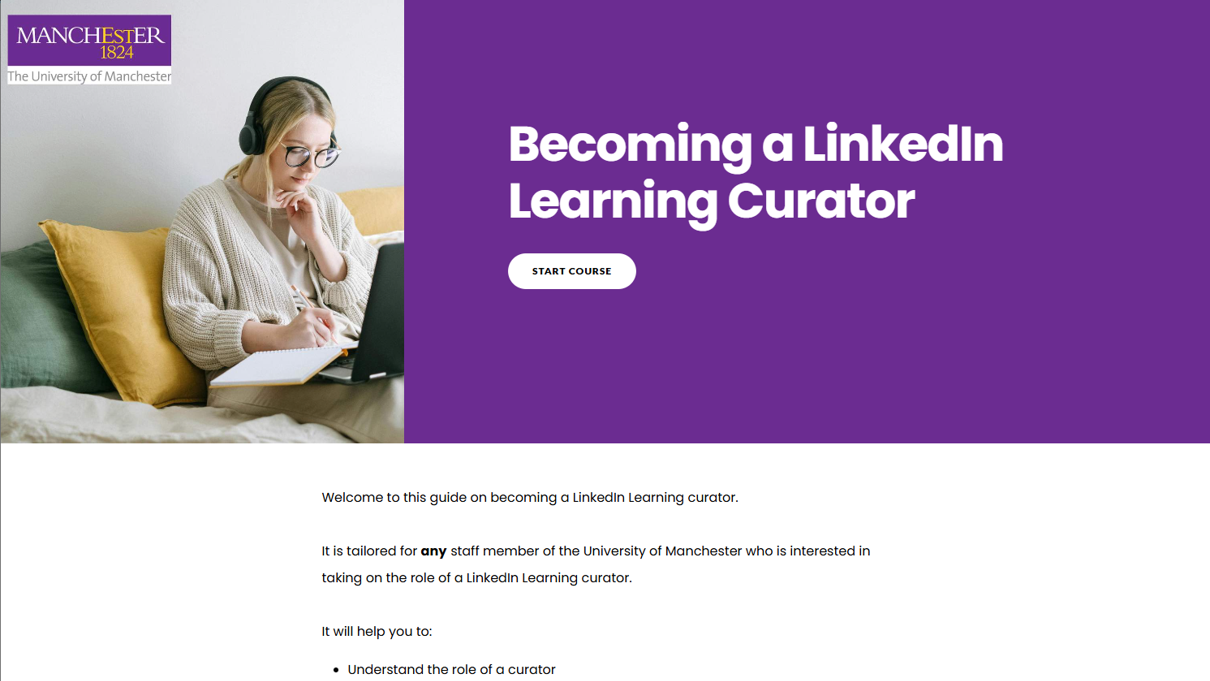
LinkedIn Learning Curator Guide: a Rise 360 module showing a step-by-step onboarding flow with clear navigation and visual headings. Rise 360
Step-by-step onboarding guide for staff taking on the LinkedIn Learning curator role.

Becoming a LinkedIn Learning Curator

  • Context: Curator onboarding relied on repeated ad hoc support — no consistent self-serve resource existed.
  • My role: Designed and built the module independently; shaped structure, tone and user flow.
  • Approach: Clear step-by-step guidance, accessibility-aware structure, practical examples aligned to curator tasks.
  • Goal: Freed staff time from one-to-one onboarding; curators now have a reliable self-serve reference they can return to.

View live Curator Guide (opens in new tab)

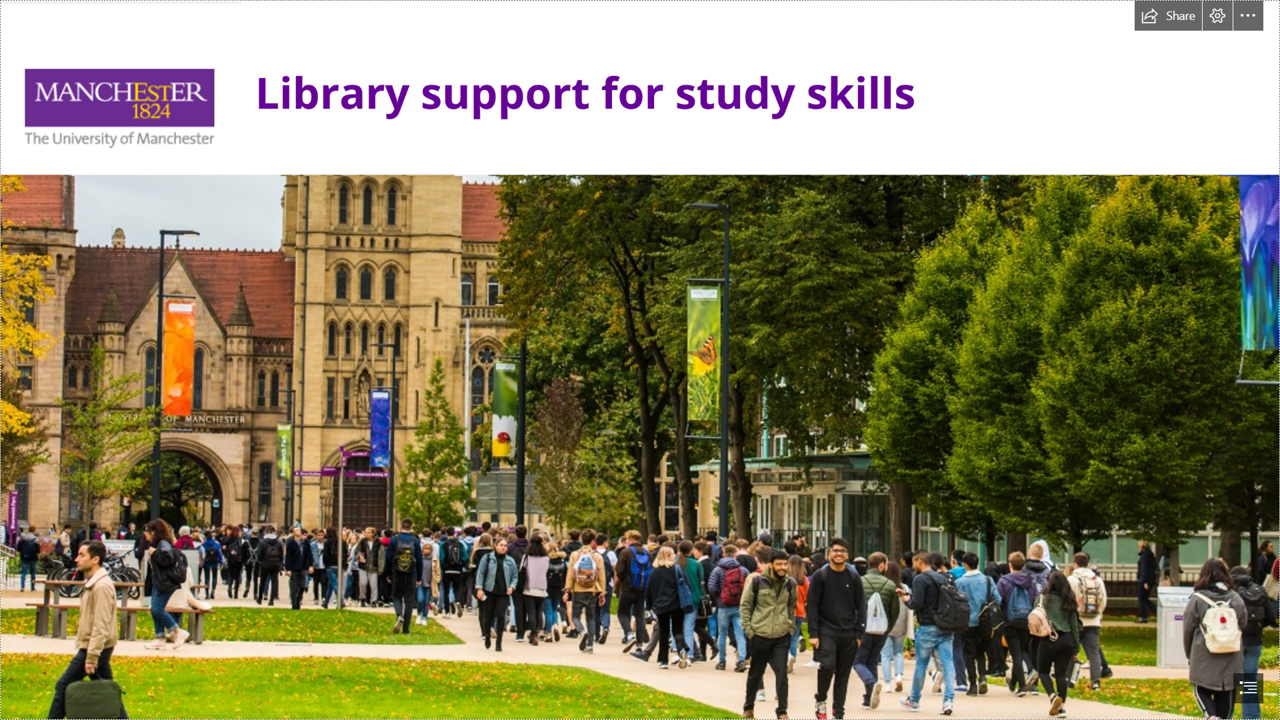
Students walking along a tree-lined pathway toward the historic Oxford Road entrance and Old Quad buildings at the University of Manchester. MS Sway
Interactive learning resources to support new Transnational Education students.

Library Support for Study Skills

  • Context: Transnational Education (TNE) students needed a clear, centralised online resource to support their transition into academic study. Existing content was dispersed across Word documents and PowerPoints, making it difficult to navigate and maintain.
  • My role: Designed and developed an interactive, user-friendly digital resource to present core academic skills clearly and coherently.
  • Approach: Structured content into accessible, mobile-friendly sections with clear navigation, visual signposting and plain English guidance, enabling both student engagement and easy academic updates.
  • Goal: Improved accessibility and usability of study skills support; provided a sustainable format that academics could maintain independently without technical assistance.

View TNE resource (opens in new tab)

Team Inspirational Action Cards: visually consistent, prompt-based workshop cards displayed in a PowerPoint slide layout. PowerPoint · ABC Toolkit
Facilitation resource providing structured prompts to support learning design conversations in workshop settings.

Team Inspirational Action Cards

  • Context: Facilitators needed a lightweight, reusable tool to structure design conversations without prior instructional design knowledge.
  • My role: Designed the card framework and visual format, drawing on the ABC Learning Design Toolkit approach.
  • Approach: Scannable prompts, consistent visual patterns, a format that works equally in print and on-screen.
  • Goal: Adopted by team members for their own workshops; reduced preparation time and produced more structured outcomes from design sessions.

View Team Inspirational Action Cards (opens in new tab)

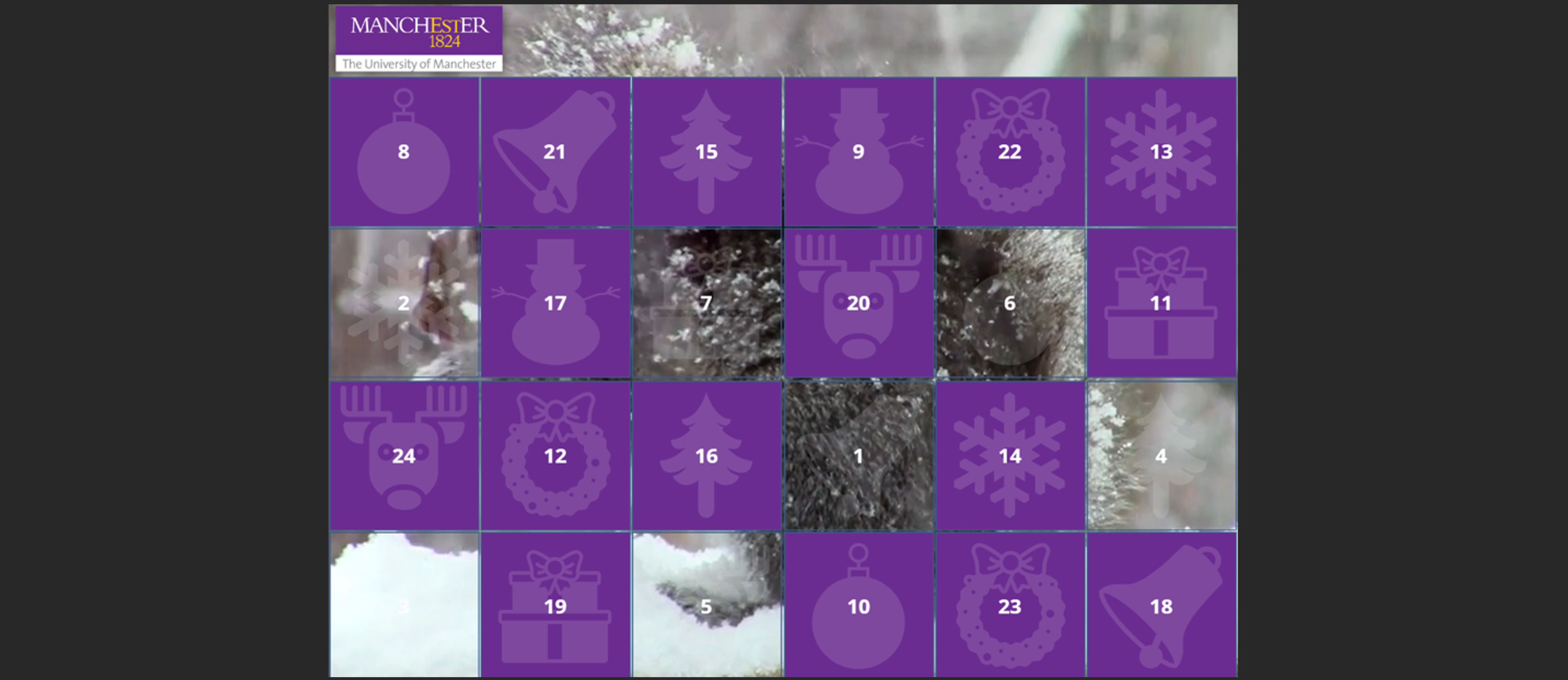
Interactive advent calendar: 24 numbered doors, each revealing a LinkedIn Learning micro-challenge for December. Storyline 360
Interactive engagement resource using a daily reveal format to sustain participation throughout December.

Digital Advent Calendar

  • Context: Engagement with self-development content typically dips outside induction and appraisal periods.
  • My role: Designed the interaction model and produced the full Storyline build.
  • Approach: Micro-activities with low barrier to entry, clear signposting and a "return tomorrow" motivation.
  • Goal: Measurably increased platform visits in December; memorable enough to generate requests to repeat the following year.

View the Digital Advent Calendar (opens in new tab)

Complex, multi-stakeholder programmes where I worked across design, production and project management, co-ordinating teams and ensuring instructional quality at scale.

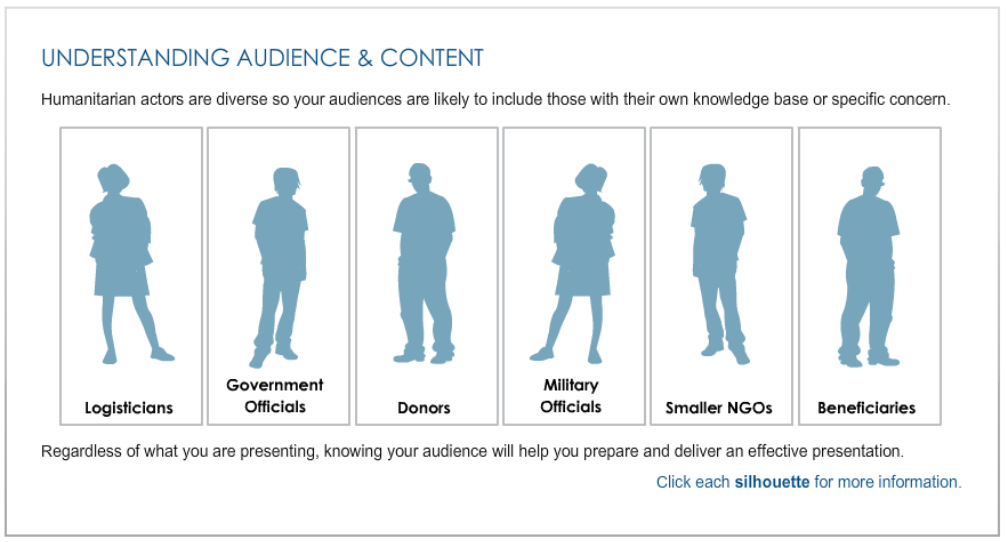
Screenshot of Service Mindset Training developed for the World Food Programme using Composica. BEHAVIOURAL DESIGN · COMPOSICA
International humanitarian training programme designed using modular learning architecture in a collaborative LCMS environment.

Service Mindset Training - Global Emergency Group & World Food Programme

  • Context: Behavioural training for humanitarian responders deployed in sudden-onset emergencies, serving both experienced and novice staff.
  • My role: Instructional Designer working with the Global Emergency Group for the World Food Programme, responsible for learning architecture, scripting and development.
  • Approach: Designed modular learning objects structured around Merrill’s Component Display Theory within Composica’s collaborative authoring environment. Implemented dual navigation pathways to support different learner confidence levels.
  • Impact: Delivered a scalable, reusable programme aligned to real-world emergency contexts, improving clarity and transfer of behavioural principles under pressure.

View Service Mindset Training sample screens (opens in new tab)

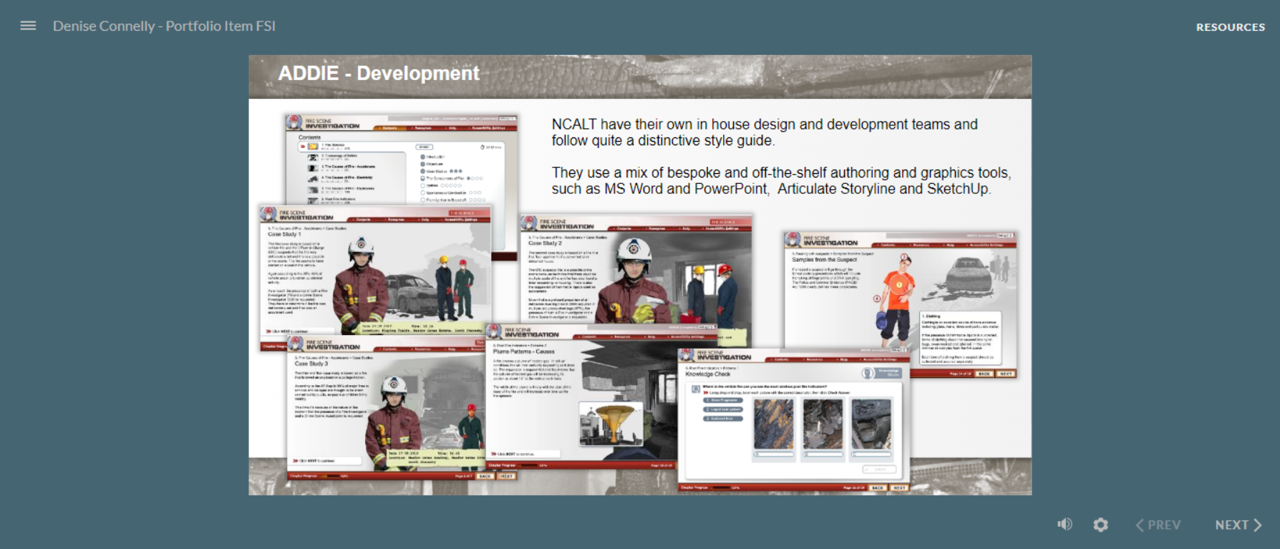
Fire Scene Investigation course overview: slides showing scenario imagery, course structure and design rationale for an emergency services eLearning programme. ADDIE · Storyline 360
Overview of a nationally commissioned emergency-services programme using scenario-led instructional design.

Fire Scene Investigation - Course Overview

  • Context: NCALT commissioned a nationally deployed FSI course for first responders across multiple services.
  • My role: As Producer I led a small team of designers, scriptwriters and developers through design and build phases.
  • Approach: ADDIE framework combined with Merrill's Principles to ensure realistic scenarios and clear learning transfer.
  • Goal: Delivered a coherent, reusable programme across a complex stakeholder environment; design decisions documented for future commissions.

View FSI course overview (opens in new tab)

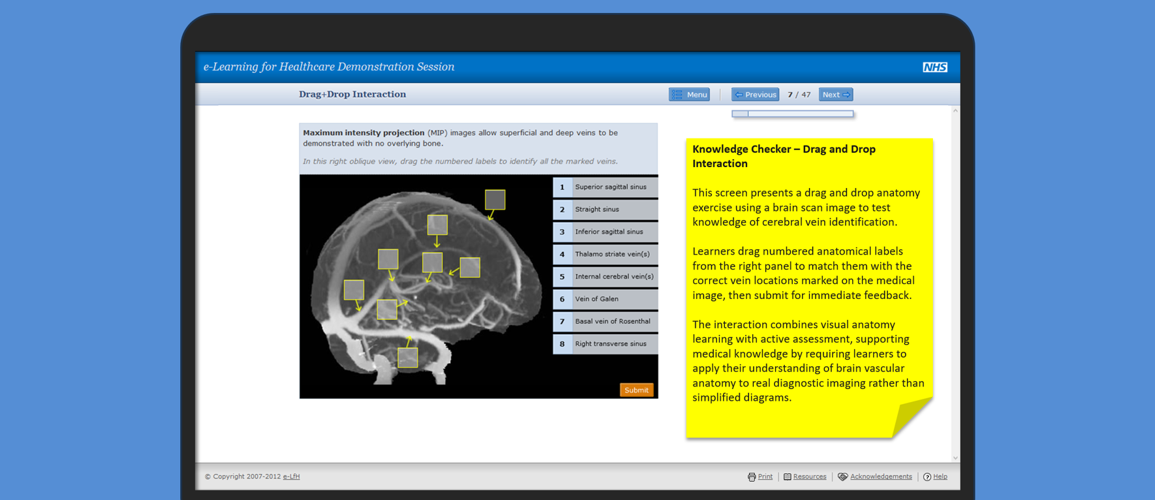
NHS eLearning for Healthcare screen designs: structured slides showing clear content hierarchy, interaction prompts and consistent visual layout. NHS eLfH · Screen design
Screen design samples demonstrating structured content hierarchy and learner-friendly interaction patterns.

eLearning for Healthcare - Screen Design Samples

  • Context: NHS learning required strict consistency to meet clinical governance and accessibility standards across a wide module range.
  • My role: Instructional Designer responsible for screen structure and interaction specifications within a wider production team.
  • Approach: Content chunked for clinical learners in time-pressured environments; interactions calibrated to support knowledge retention.
  • Goal: Screen patterns adopted as templates programme-wide, reducing rework and ensuring a consistent learner experience.

View eLfH screen design samples (opens in new tab)

Standalone interactive resources designed for events, workshops and self-directed use where engagement, accessibility and low barrier to participation are the primary design constraints.

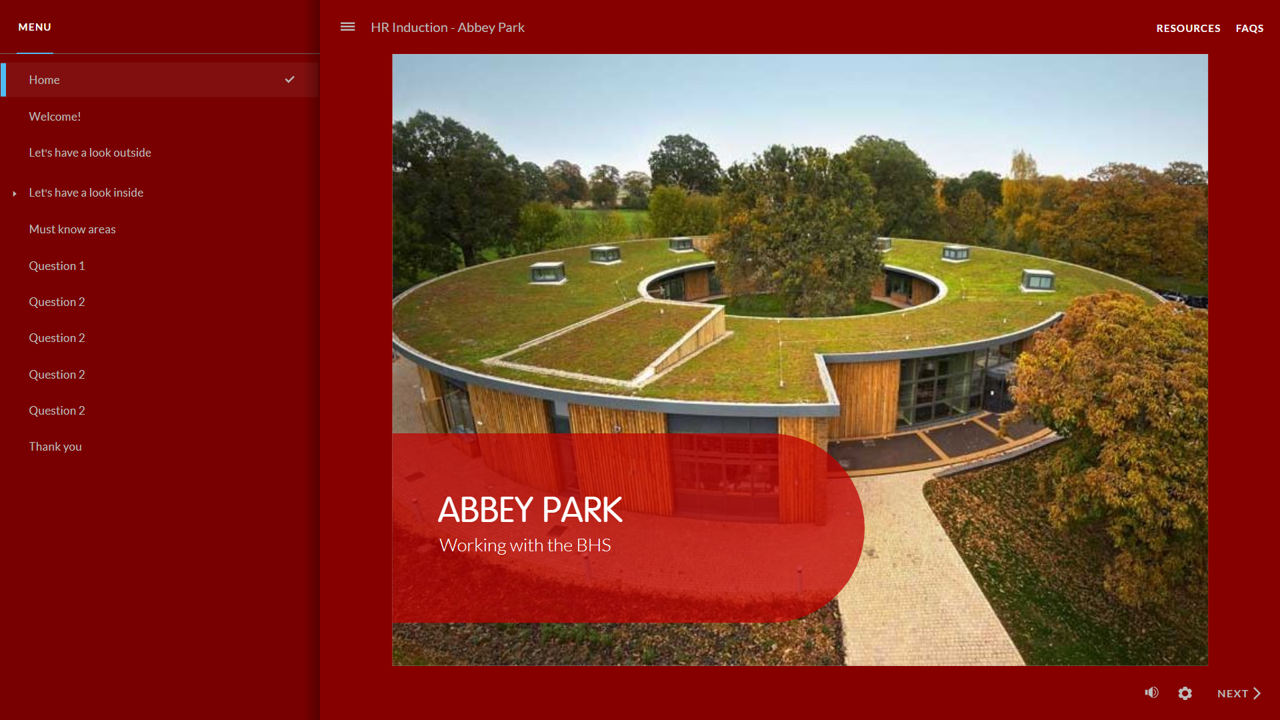
Screenshot from the HR Induction eLearning module featuring the iconic, doughnut shaped British Horse Society headquarters. Storyline 360
Interactive HR induction programme designed to balance compliance, engagement and organisational culture.

HR Induction - Abbey Park

  • Context: New staff required a structured yet engaging induction experience that balanced essential HR compliance information with organisational culture and values.
  • My role: Led the instructional design and development of an interactive eLearning induction programme, shaping navigation, interaction design and learner journey.
  • Approach: Designed a dual-mode experience including a structured pathway "Give Me A Tour" and a “Let Me Explore” mode, allowing learners to navigate content at their own pace. To increase engagement and reinforce organisational identity, I embedded hidden “easter egg” horse icons throughout the exploratory mode with "fun facts about horses" - encouraging curiosity, interaction and deeper content discovery.
  • Goal: Transformed mandatory induction into a more engaging, self-directed learning experience, improving learner motivation while maintaining compliance and consistency of core HR messaging.

View HR Induction - Abbey Park (opens in new tab)

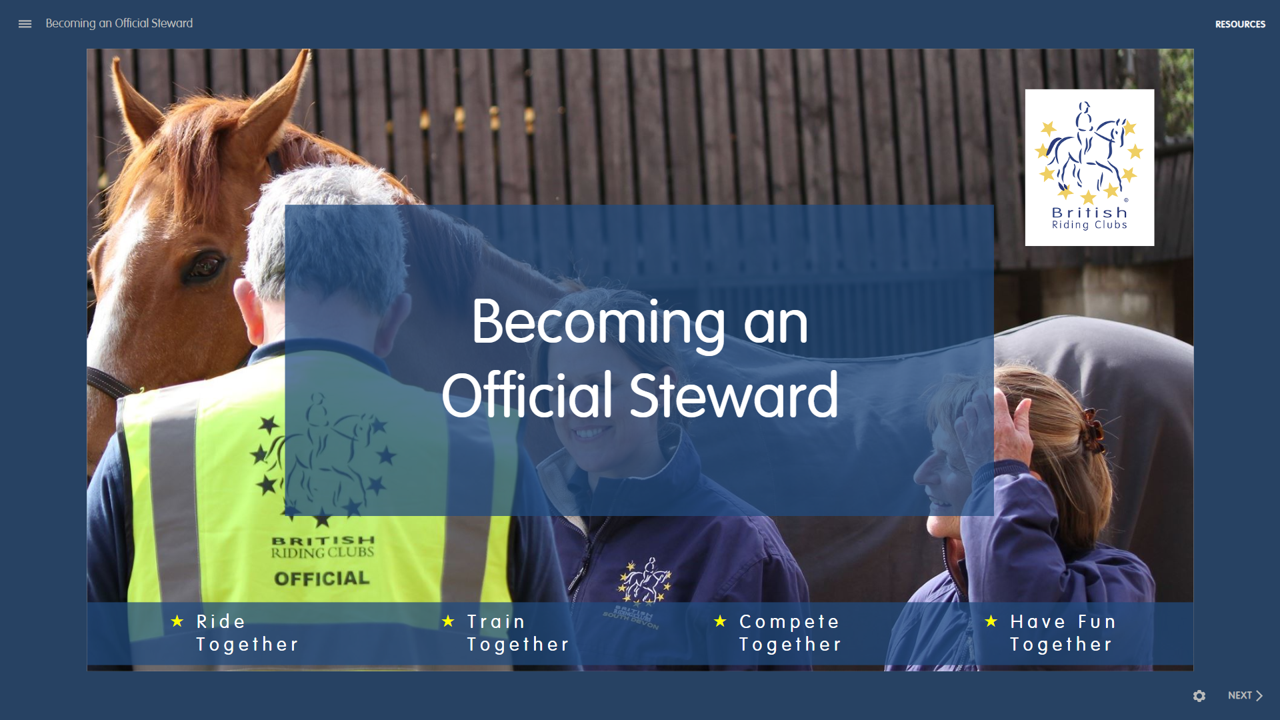
Screenshot from the Becoming an Official Steward eLearning module featuring a steward in a high-visibility vest assisting at a horse riding event. Storyline 360
Blended learning module designed to prepare volunteer stewards through scenario-based, confidence-building training.

Becoming an Official Steward

  • Context: British Riding Clubs required consistent, accessible online training to prepare volunteer stewards for event responsibilities across a variety of activities.
  • My role: Led the instructional design and development of an interactive eLearning module, shaping content structure, scenario flow and learner experience.
  • Approach: Applied blended learning principles and clear, step-by-step interaction design to ensure accessibility, confidence-building and practical relevance. Incorporated scenario-based elements and structured knowledge checks.
  • Goal: Provided scalable pre-event training, reduced reliance on face-to-face delivery and improved volunteer preparedness and confidence.

View Becoming an Official Steward (opens in new tab)

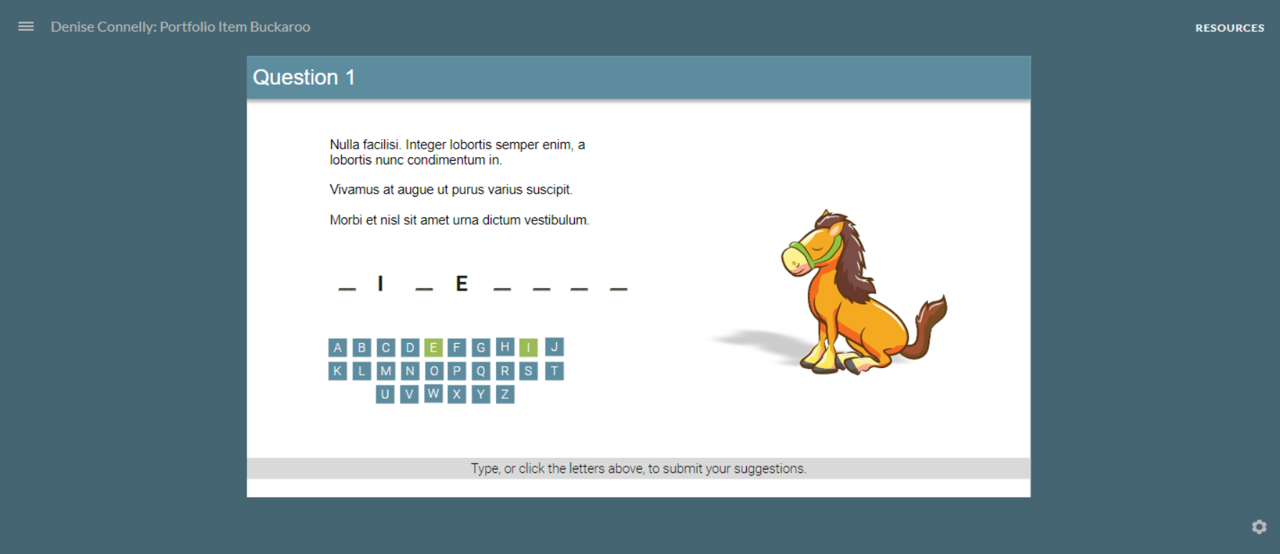
Accessible Buckaroo quiz: a Storyline interaction with a game-style layout, clear feedback states and keyboard-navigable controls. Storyline 360
Game-style quiz designed for inclusive participation at digital skills events, with keyboard-friendly controls and clear feedback.

Accessible Buckaroo Quiz

  • Context: Standard quiz formats risked excluding participants with lower digital confidence or accessibility needs.
  • My role: Designed the interaction concept and built the resource in Storyline with keyboard navigation throughout.
  • Approach: Simple, familiar game mechanic; clear feedback at every step; keyboard-navigable for participants who cannot use a mouse.
  • Goal: Used successfully at multiple events; prompted other team members to explore accessible interaction design.

View Accessible Buckaroo Quiz (opens in new tab)

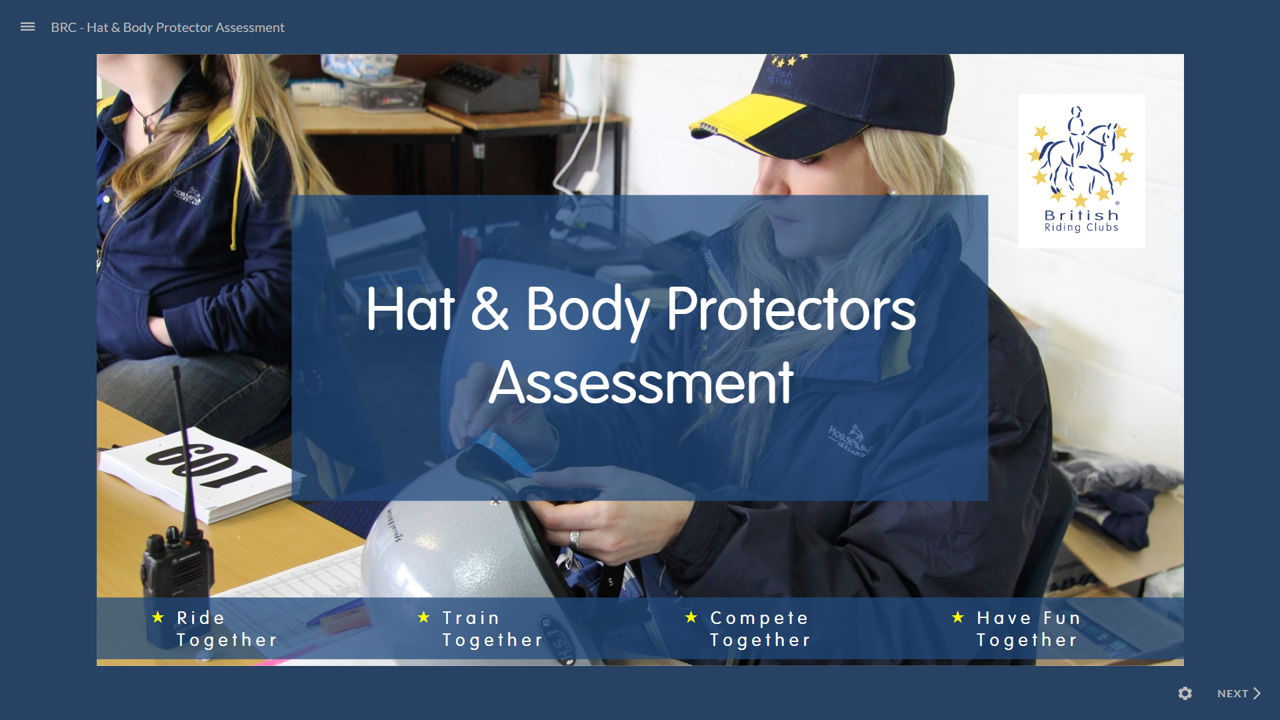
Screenshot from the BRC Hat & Body Protector Assessment eLearning. Storyline 360
Interactive safety assessment designed to reinforce compliance, consistency and confident on-event judgement.

Hat & Body Protector Assessment

  • Context: British Riding Clubs required a consistent and reliable method for assessing hat and body protector compliance at events, ensuring safety standards were applied uniformly by volunteer stewards.
  • My role: Designed and developed a digital assessment module that included access to hat and body protectors guides, feedback logic and assessment criteria to reflect real-world event conditions.
  • Approach: Using photos of actual hats and body protectors likely to be presented during an event the assessment required learners to apply safety rules rather than simply recall information. Integrated structured knowledge checks, immediate feedback. Designed for accessibility and clarity to support volunteers with varied digital confidence.
  • Goal: Improved consistency in safety compliance decisions, strengthened steward confidence in applying regulations, and reduced ambiguity during live event assessments.

View the Hat & Body Protector Assessment.(opens in new tab)

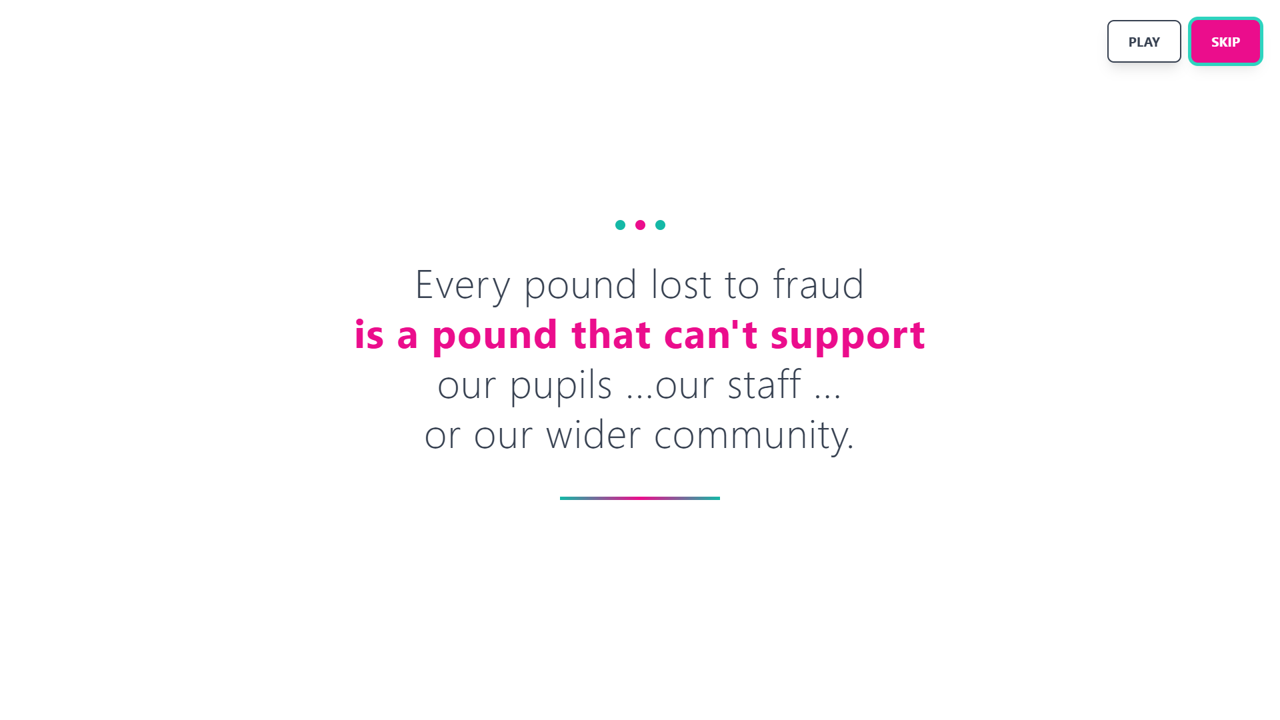
Screenshot from the Fraud is a BIG problem splash screen. HTML/CSS/JavaScript/React/Bable/Tailwind CSS
High-impact HTML splash sequence designed to visualise the scale and impact of fraud through animated data storytelling.

Fraud is a BIG problem

  • Context: Required an engaging digital introduction to highlight the scale, urgency and societal impact of fraud before learners entered scenario-based training.
  • My role: Designed and developed an interactive HTML splash sequence using React and Tailwind CSS, shaping narrative flow, animation timing and visual emphasis.
  • Approach: Applied data storytelling techniques including timed scene transitions, animated count-up visualisation, progressive text reveals and comparative framing to reinforce emotional and cognitive impact.
  • Goal: Increased learner attention and engagement at the start of mandatory compliance training, establishing relevance and urgency before progressing to applied scenarios.

View the Fraud is a BIG problem splash screen.(opens in new tab)

A consistent set of standards underpins every project — regardless of scale, tool or stakeholder context.

  • Accessibility: WCAG-informed structure, readable layouts, keyboard-navigable interactions and meaningful alt text throughout.
  • Data protection: GDPR considerations applied when working with learner data, platform reporting and third-party tools.
  • Evaluation: engagement analytics and learner feedback used to identify what works, what needs refinement and what the data shows stakeholders.
  • Scalability: reusable templates and documented patterns reduce dependency on individuals and sustain quality as teams grow.